
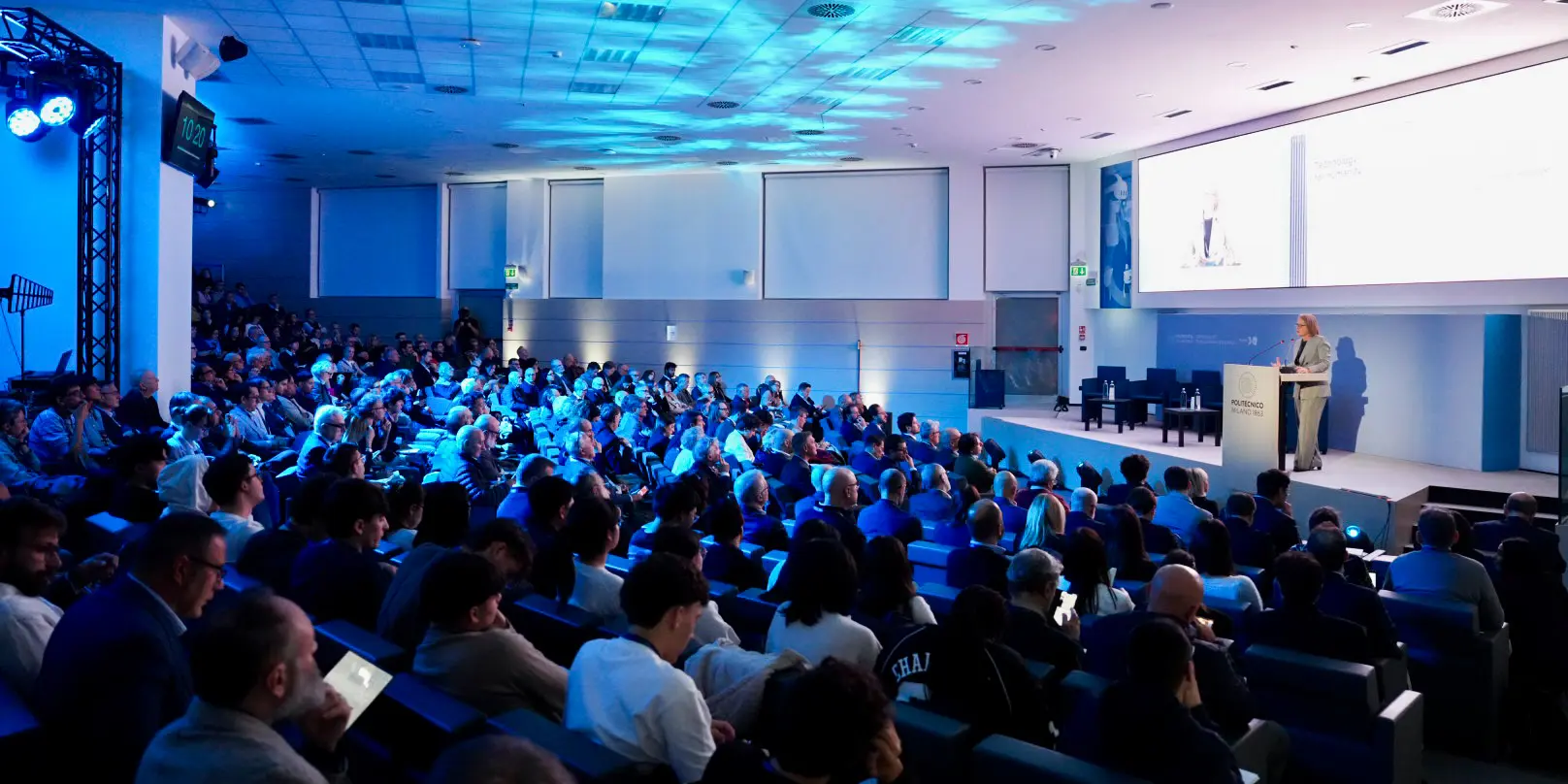
How can digital technologies and artificial intelligence solutions be designed, adopted and governed in ways that are sustainable, inclusive and focused on people's well-being? This was the central theme of “Human Agency in the AI Era – Research and Industry Supporting Human-Centred Technologies and Innovation”, an event organised on 27 October by the Department of Management, Economics and Industrial Engineering at Politecnico di Milano.
The event brought together approximately 400 participants from academia, industry and institutions, opening with a keynote speech by Paolo Benanti, a leading figure in the international debate on ethics, artificial intelligence and responsible innovation. This was followed by a contribution from Alvise Biffi, President of Assolombarda, and a roundtable discussion featuring representatives from EssilorLuxottica, Errevi Automation - Exotec, Save the Children Italia, Menarini Group and Banca Mediolanum. The programme also included six thematic workshops, laboratory visits and meetings with research teams to explore applications of digital technologies and opportunities for collaboration.
At the heart of the event was HumanTech – Humans and Technology, the Department's research project exploring the relationship between people and digital technologies, with the aim of fostering more sustainable, inclusive and human-centred industrial systems.
Funded by the Italian Ministry of University and Research under the Departments of Excellence initiative for the period 2023–2027, HumanTech brings together over 80 research activities combining technological, economic and management expertise with behavioural and social sciences. The project aims to develop models and solutions that support digital transformation while placing people, organisations and societal impact at its core.
Research is structured around three main areas: the design of human-centred digital technologies, the development of resilient and sustainable production processes and supply chains, and the creation of organisational models that recognise and enhance people's contributions in technology-intensive environments.
“HumanTech aims to reshape the relationship between technology and people to support a sustainable digital transition in industrial systems, through technological development models that also take into account their implications for individuals, society and the environment. Today, HumanTech represents a strategic platform for contributing to the global debate on how to design and govern technologies while keeping people at the centre and creating value for organisations and society. With one year remaining until the project's scheduled completion, the challenge is to pursue frontier research, strengthen our international scientific standing and expand collaborations with industry to increase the economic and social impact of the results achieved.”
Raffaella Cagliano, Head of the Department of Management, Economics and Industrial Engineering at Politecnico di Milano.
HumanTech's research activities are supported by three experimental research facilities that enable researchers to investigate different dimensions of the interaction between people and technologies.
The Marco Garetti Laboratory, dedicated to experimenting with industrial technologies in production and logistics settings, investigates how operators and industrial technologies interact in manufacturing environments. Researchers work with collaborative robots, exoskeletons, wearable sensors, and virtual and augmented reality technologies to improve worker safety, ergonomics and well-being. One of the projects developed involves a system that uses biometric data collected through wearable sensors to estimate workers' physical, cognitive and emotional stress levels, supporting the design of safer and more sustainable working environments.
The BRIEL – Behavioral Research in Immersive Environment Laboratory focuses on studying people's emotions, behaviours and decision-making processes in real-world, immersive and controlled environments. Using technologies such as electroencephalography, eye-tracking and physiological sensors, researchers analyse people's behavioural and psychophysiological responses, including the effects of AI-assisted decision-making on cognitive load, stress and decision-making processes. The laboratory's activities contribute to a better understanding of people's cognitive and behavioural processes in organisational and technological contexts.
The third facility is the DataHub Lab, a high-performance computing infrastructure dedicated to advanced data analytics and artificial intelligence. Through its computing resources, the laboratory supports the development of models to address complex challenges across industrial and scientific domains. One notable application involves research into smart warehouses, where people and robots share the same operational spaces. Using high-performance computing resources and optimisation models, researchers have developed solutions to plan robot routes dynamically and in real time, combining operational efficiency with worker safety.
The three facilities form the experimental core of HumanTech, enabling an integrated approach to the technological, cognitive and organisational implications of digital transformation. Research activities are complemented by international scientific collaborations, PhD programmes, and education and knowledge dissemination initiatives aimed at the academic community and industry.