
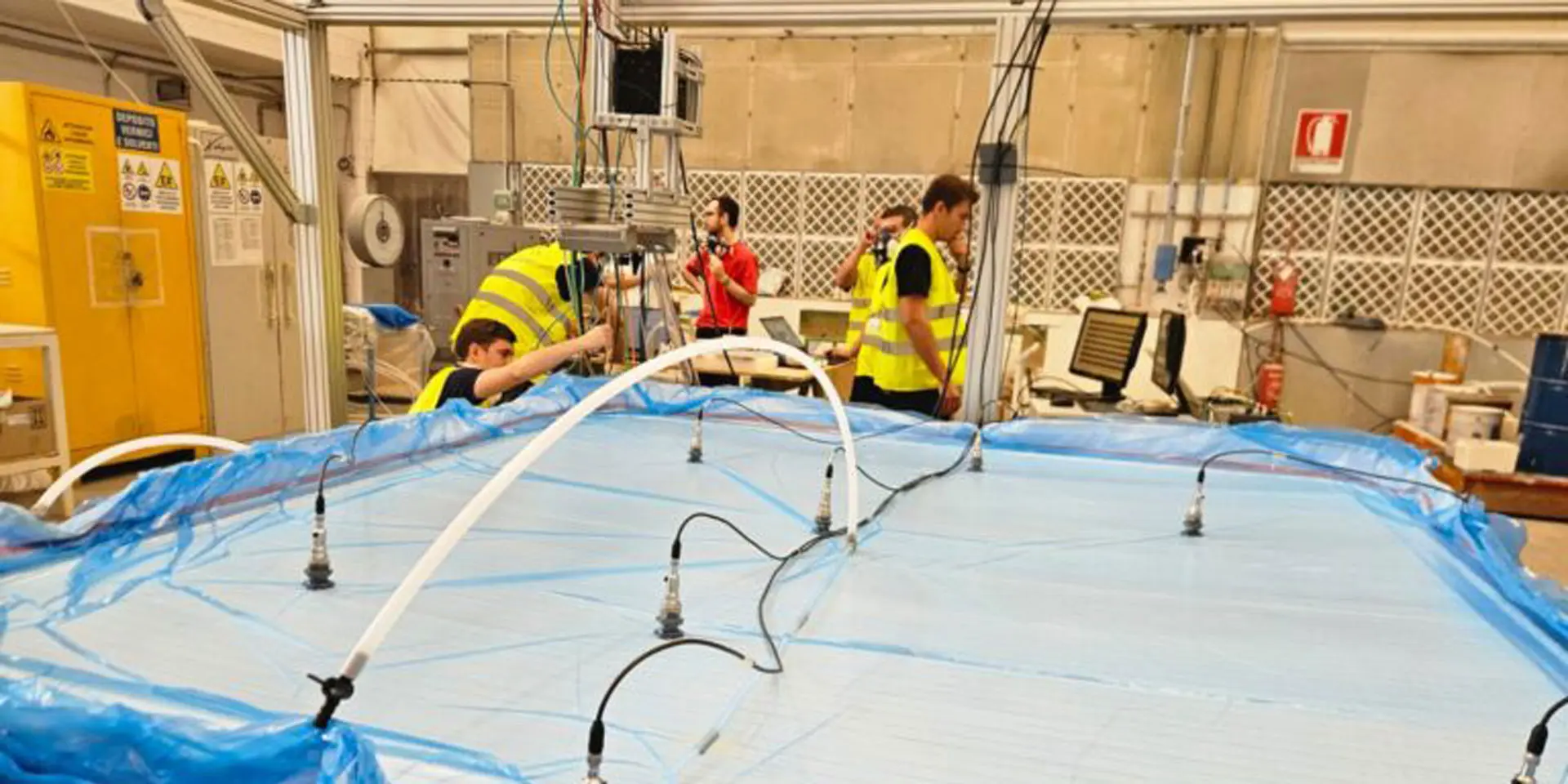
Following three years of research and experimentation, the Horizon Europe project has concluded, delivering new digital solutions to the industry that reduce defects and waste in composite manufacturing.
Developing more efficient and sustainable processes is key to preventing defects before they compromise the final product. This is the aim of FLASH-COMP, a project funded by the Horizon Europe programme involving 13 European partners, including universities and research centers, technology firms and industrial organizations.
Coordinated by the Spanish technology center LORTEK, FLASH-COMP has brought together expertise in sensor technology and inspection systems, artificial intelligence, data management, automation and sustainability, guiding the solutions from research through to testing in real production environments.
The project has developed a quality control system that combines advanced monitoring and inspection technologies, artificial intelligence, and decision support tools. The system helps to ensure that any defects are detected promptly, supporting operators in taking corrective action. The objective is to adopt a right first time approach with a focus on Zero Defect Manufacturing.
Particular attention has been paid to Liquid Resin Infusion (LRI) processes, which are used to manufacture large composite components for sectors such as marine, aerospace and energy. Reducing defects, rework and waste improves efficiency whilst minimizing material and resource consumption. FLASH-COMP aims to reduce waste by more than 30 per cent.
The solutions were tested in two industrial use cases — with Azimut-Benetti in the marine sector and Israel Aerospace Industries in the aerospace sector — to enable their application to be assessed in different contexts.
Within the project, the Department of Management, Economics and Industrial Engineering of Politecnico di Milano focused particularly on evaluating the sustainability of zero-defect and zero-waste solutions by analyzing their economic, environmental, and social impacts. The Department also contributed to the development of the FLASH-COMP Data Space by working on models and guidelines to facilitate the secure and interoperable sharing of industrial data.
The FLASH-COMP project concluded with an Industry Event held at the Azimut plant in Avigliana, Turin, on 24 September 2026. Entitled “From research to production on the factory floor” the event brought together researchers, technology partners, and industry representatives to present the results achieved and discuss future prospects.
The day focused on the transition from technological validation to industrial adoption, particularly in relation to Zero Defect Manufacturing and eco-efficiency. Participants were also able to tour the Azimut plant and witness a live FLASH-COMP demonstration.
FLASH-COMP has left behind technologies and expertise that can help to make the production of composite materials more efficient, sustainable, and geared towards zero defects.