
The research project, “The relationship between workspaces and gender in academia: an interdisciplinary approach”, which was funded under the PRIN PNRR program and carried out by the Department of Management, Economics and Industrial Engineering at Politecnico di Milano, has now concluded. Led by Cristina Rossi-Lamastra and Alessandra Migliore, the project was carried out in collaboration with Silvia Donato, Professor at the Università Cattolica del Sacro Cuore.
The project investigated the relationship between workspaces, inclusion, inequalities, and well-being in knowledge work, focusing particularly on the academic context and gender dynamics. Using an interdisciplinary approach, the project analyzed how various environments, ranging from offices to domestic spaces and the urban context to the symbolic dimensions of the built environment, influence participation in work and professional opportunities.
The findings emphasize that workspaces are not neutral; they impact professional visibility, productivity, access to opportunities, the management of boundaries between work and private life, and employees’ sense of belonging. The study therefore contributes to the debate on the future of work by emphasizing that inclusion depends not only on organizational policies and practices, but also on the design, accessibility, and everyday use of physical and hybrid workspaces.
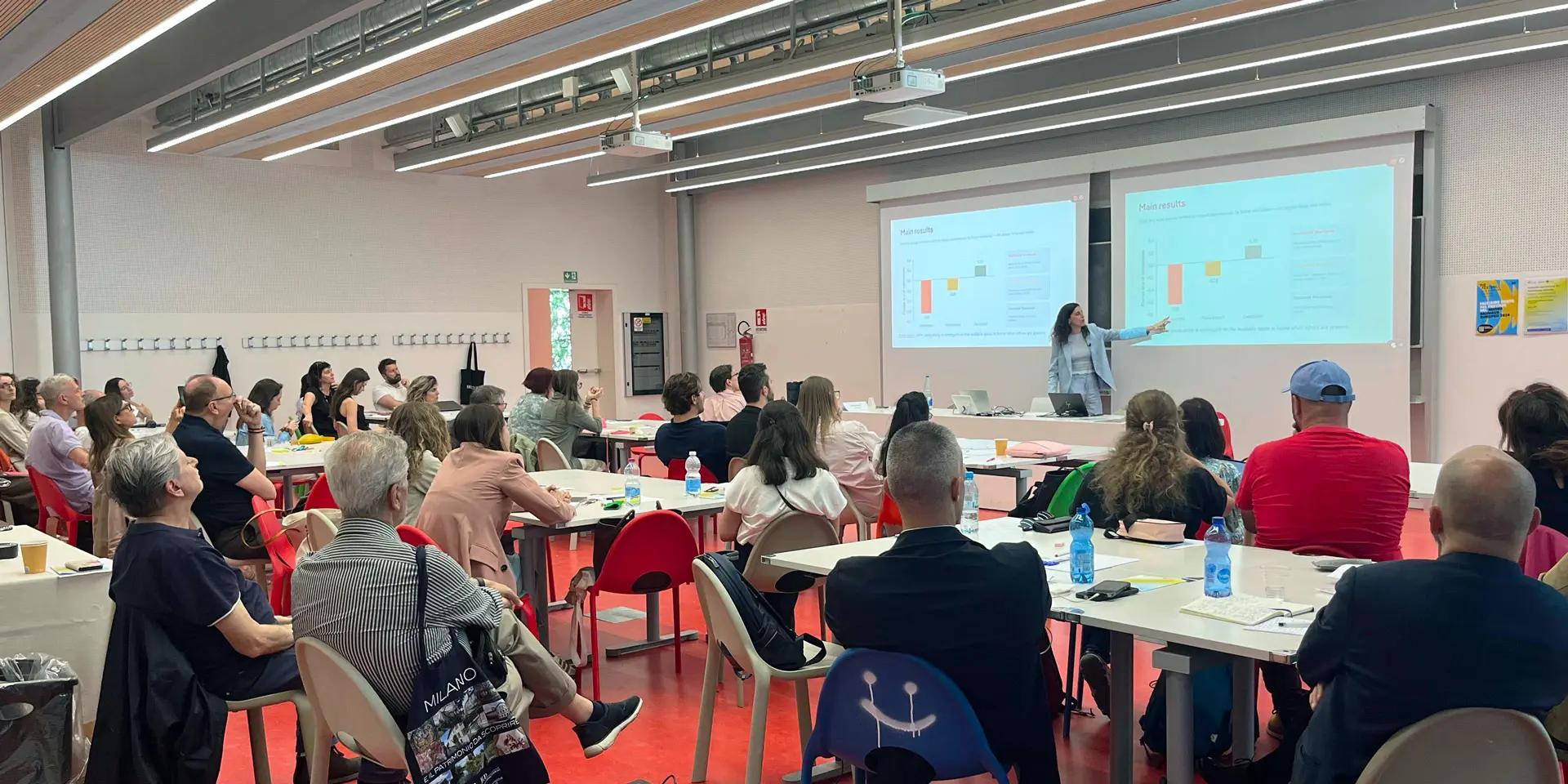
The project concluded with the event “Inclusive workplaces for knowledge workers: Spaces, organizational practices and relations” which was hosted by the Politecnico di Milano as part of the New European Bauhaus Satellite Event. This event is linked to the New European Bauhaus program, which promotes innovative and inclusive approaches to designing living and working spaces. The event brought together researchers and professionals to discuss strategies and tools for designing, governing and evaluating inclusive workplaces at various scales, from domestic to urban.
Presentations on topics such as remote and hybrid work, workspaces and gender, home-based work environments, meaningful work, craftsmanship, housing accessibility and the role of the city in access to professional opportunities were given during the meeting. The practitioners' session also facilitated discussions on participatory processes, urban spaces, accessibility, and the economic sustainability of workplaces. Particular focus was given to the needs of workers and the role of small and medium-sized enterprises in the Italian and Lombardy contexts.
The project highlights the importance of viewing workplaces as a strategic means of understanding and managing contemporary work transformations, thereby contributing to the creation of more inclusive, equitable and sustainable environments.