
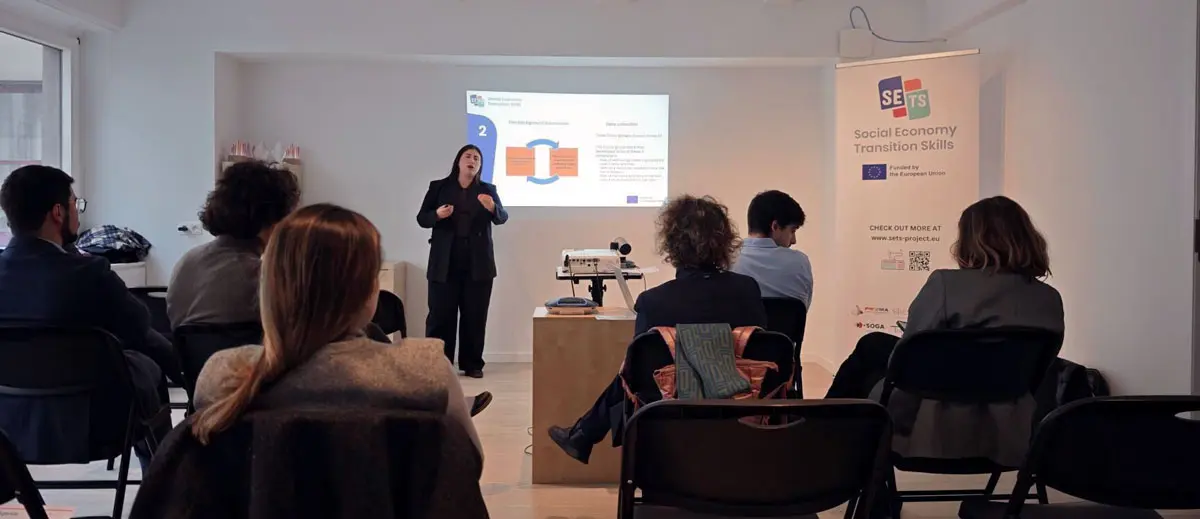
The European project SETS – Social Economy Transition Skills came to an end in December 2025. The two-year initiative, funded by the Horizon Europe programme, was launched with the aim of building a European network capable of addressing digital and green skills gaps among social economy actors. The Department of Management, Economics and Industrial Engineering of Politecnico di Milano was among the partners involved in the consortium.
Launched in 2023, SETS fits within the broader framework of European policies supporting the modernisation of the social economy, contributing to the so-called twin transition through the development of digital skills aligned with economic and social sustainability objectives. The project aimed to support, test and plan training pathways capable of responding to the concrete challenges faced by cooperatives, social enterprises and non-profit organisations.
The project adopted a dual approach:
- it developed reskilling pathways targeted at social economy actors, providing the knowledge and tools needed to address current challenges and digital transformation processes;
- it worked on the training of European service providers (responsible for reskilling activities), with the aim of strengthening their understanding of the dynamics, values and specific characteristics of the social economy. This helped improve the effectiveness of training initiatives and foster closer collaboration between the technology sector and social organisations.
Over the course of the project, three core training courses were developed to support skills development:
- Communication and collaboration in digital contexts, designed to support organisations in the transition from physical workplaces to digital and hybrid working environments;
- Artificial intelligence to support social economy organisations, aimed at maximising the impact of AI within organisations, from introducing basic concepts to enabling participants to identify and select the most appropriate AI tools for different organisational needs;
- Foundations of Impact Management, developed to provide service providers with a clear understanding of the social economy in Europe, facilitating dialogue and collaboration with social economy actors such as cooperatives, social enterprises and non-profit organisations.
The courses were piloted in France and Slovenia, gathering valuable feedback from participants. The results of the testing phase were integrated by the project team to finalise the training pathways and maximise their effectiveness in strengthening organisational capabilities.
At the conclusion of the project, a rigorous assessment of the overall economic and social impact of SETS was also carried out, with the aim of documenting and communicating the tangible changes generated by the project’s activities.
Politecnico di Milano played an active role in the project, contributing to the following Work Packages (WP):
- WP2, through in-depth research analysing skills gaps within social economy organisations;
- WP3, through the development of training programmes and the finalisation of course content;
- WP7, by participating in dissemination activities during the final phase of the project.
The results of SETS were presented at the Final Conference “Empowering Tomorrow: Transition Skills for the Social Economy”, held on 11 December 2025 in Brussels. The event provided an opportunity for partners and stakeholders to reflect on the project’s legacy and on future perspectives for continuing to build knowledge in support of a fairer and more inclusive digital and green transition.
The SETS project was coordinated by Diesis Network (Belgium). In addition to Politecnico di Milano, project partners included All Digital AISBL, Open Impact Srl, Social Good Accelerator, Fundacija za Izboljšanje Zaposlitvenih Možnosti PRIZMA, and the European Forum of Technical and Vocational Education and Training.
For the Politecnico di Milano, the project involved Mario Calderini, Veronica Chiodo and Edoardo Cortesi of the Tiresia Research Center, dedicated to the study of social and technological impact-driven innovation.
For further information, please visit the project’s official website: https://sets-project.eu/