
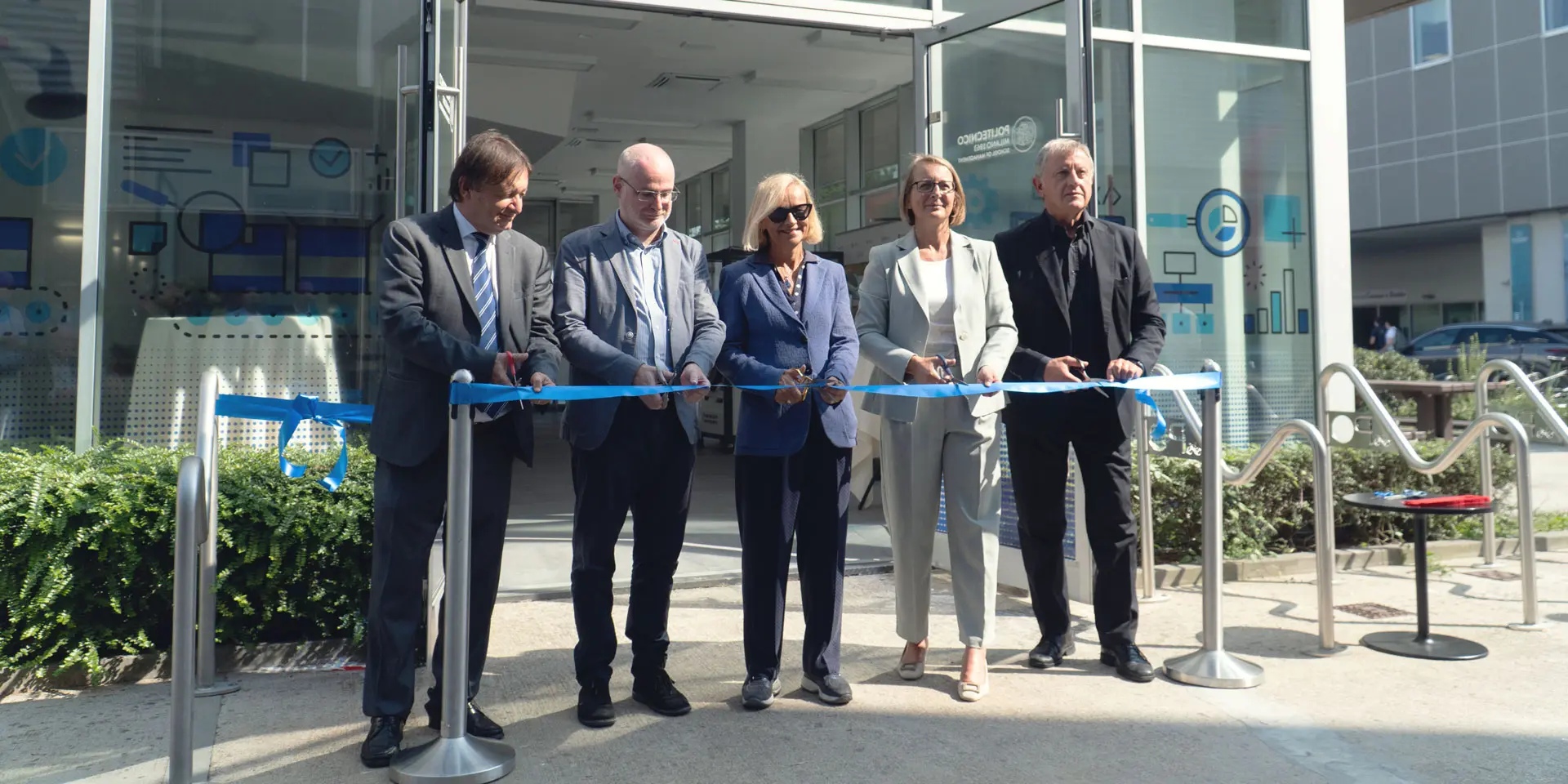
The Marco Garetti Laboratory is in the Department of Management, Economics and Industrial Engineering at the Politecnico di Milano, and entering it is like stepping across a symbolic threshold: one that separates the traditional concept of the factory from a reality in which technology, industrial processes and people are all inseparable. Where there was once a bar, there is now a “miniature” factory, designed not to produce, but to observe, simulate, and experiment. Professor Sergio Terzi, the scientific director of the Lab, explained a context that involves Industry 4.0, Cognitive Ergonomics, and collaborative robots and which, above all, puts human beings at the centre of this digital world.
How it started
The Marco Garetti Lab was not the result of a top-down plan, but rather developed from the practical need for a research facility. As Prof. Terzi explained: “This has already been in existence for several years. There was once a bar on this site. Then we [the research team known as the Manufacturing Group of the Department], slowly changed it into a laboratory, which we called the Industry 4.0 Lab.” This was the time when Italy was also starting to discuss the fourth industrial revolution, and we wanted to create a demo centre: a place for displaying technologies that normally remain invisible, such as the software used for production control, process simulation, and data collection and analysis.
The lab was designed to be a Teaching Factory, right from the start. As Prof. Terzi explained: “It still remains a mini factory, one not used for production, but rather as a demonstration space to practise simulations and apply algorithms in a setting that resembles a real one.”
The name is not accidental. The Laboratory is dedicated to Prof. Marco Garetti, Full Professor of Industrial Technologies, who died in 2016 and was the founder of the research group. As Prof. Terzi recalled: “He was our professor, we grew up with him. He created our group and he always worked in the industrial sector, combining information technology, automation and production processes. It was important to us that this lab should bear his name.”
The mission today
The Laboratory has reinvented itself in recent years. The turning point was a meeting with the “HumanTech – Humans and Technology” project, funded by the Ministry of University and Research as part of the “Departments of Excellence 2023-27” initiative, which Prof. Terzi has taken part in right from the start. The basic aim is clear: to investigate the role of the human being in digital systems. In the case of the Marco Garetti Laboratory, this means regarding the factory as an ecosystem in which advanced technologies and operators coexist and interact.
As Prof Terzi explained: “We have combined the idea of Industry 4.0 with what is known in scientific terminology as Cognitive Ergonomics. So, this is not only about automation and software, but also looks at the stress, tiredness, distraction and cognitive load of human beings. A factory that is progressively more digital needs operators who are ever more closely involved, and the lab is a place to study this relationship before the factory starts production.
The Marco Garetti Laboratory is now regarded as an asset to the whole Department of Management, Economics and Industrial Engineering. As Prof. Terzi pointed out: “It aims to be a lab for the entire department, a shared platform for pre-competitive research, mainly involving collaborative projects.” The new spaces in the Marco Garetti Laboratory were officially opened in September 2025. The former bar has been fully renovated and well equipped thanks to the HumanTech (MUR) project, with co-financing from the MICS (Made In Italy Circular and Sustainable, Spoke 5) Extended Partnership and contributions from the University, thus implementing a strategic plan for upgrading the infrastructure used for research.
To read the full interview, go to the Frontiere website.