
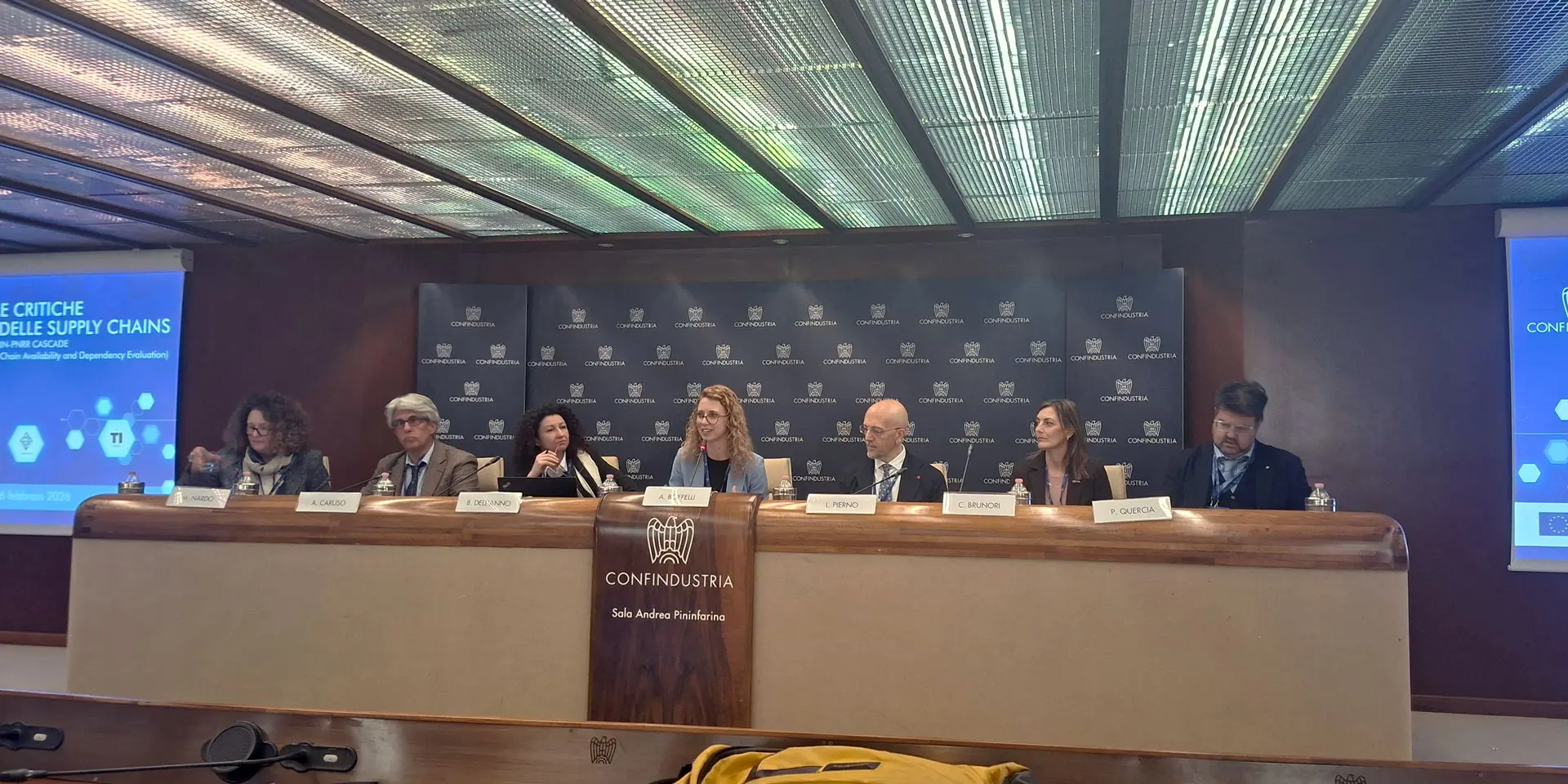
The CASCADE project comes to a close: two years of research on critical raw materials show how to address vulnerabilities and risks in Italian and European supply chains, balancing sustainability and industrial policy.
On February 26, the event “Critical Raw Materials and Supply Chain Resilience” was held in Rome, at Confindustria, to present the results of the PRIN-PNRR CASCADE Criticality Analysis for Supply Chain Availability and Dependency Evaluation project, which concluded two years of research funded under the National Recovery and Resilience Plan.
Ensuring the availability of critical raw materials is now a strategic priority for Europe. Geopolitical instability, protectionism, and supply chain vulnerabilities require coordinated responses from industry, policy makers, and the research community.
The CASCADE project, carried out by the inter-university network Re4It – with the University of Bologna as coordinator, the Politecnico di Milano, University of Bergamo, and University of L’Aquila – in collaboration with the Centro Studi Confindustria, analyzed critical dependencies of Italian and European industry with respect to four key raw materials: aluminum, copper, titanium, and rare earths. The study examined strategic sectors such as aerospace, defense, industrial automation, mobility, and renewable energy.
For the Department of Management Engineering at Politecnico di Milano, professors Antonella Moretto, Stefano Elia, Matteo Kalchschmidt and Alessio Ronchini participated, contributing to the analysis of vulnerabilities along global supply chains and to the prospective assessment of supply risks over the next five years.
The other members of the project are Paolo Barbieri and Pietro De Ponti from the University of Bologna, Cristina Pensa from Confindustria Rome, Albachiara Boffelli and Daniele Paparusso from the University of Bergamo, and Luciano Fratocchi from the University of L’Aquila.
The results show a gradual tightening of supply conditions, caused by price volatility, geographic concentration of supply, and geopolitical tensions, with greater impacts on high-tech sectors. Sustainability and recycling improve the environmental profile of supply chains, but only in the case of rare earths do they significantly contribute to the overall resilience of supply chains.
The event, organized by Cristina Pensa, from Confindustria, provided an important opportunity for dialogue between academia, industry, and institutions on global value chains, European strategic autonomy, and the policies needed to strengthen the competitiveness of the production system.