
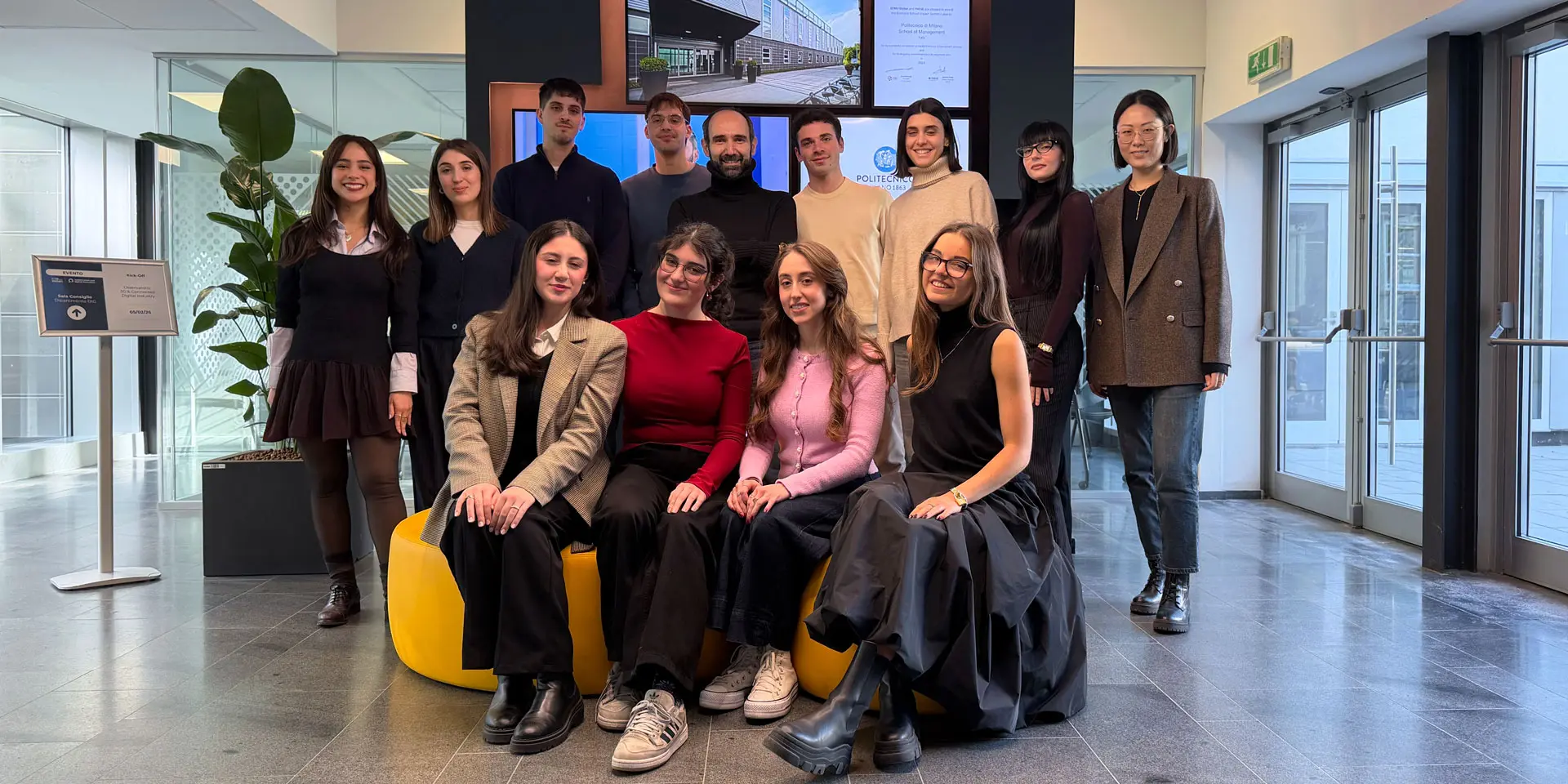
In a week when attention was focused on runways, collections and creative direction, a group of students from the High-End and Luxury Industries Management Master’s programme at Politecnico di Milano proposed shifting the focus to what lies behind the product: supply chains, artisanal skills and relationships between brands and suppliers.
Rethinking the value of luxury in a more equitable way
The manifesto, entitled “Future of Luxury: Resilient, Sustainable and Human-Centric Supply Chains”, was developed during a workshop coordinated by Professor Hakan Karaosman, Professor Jinou Xu and PhD candidate Lyven Mariana Leal Chagas and brings together eleven principles for rethinking the luxury industry in a more equitable, transparent and people-centred way.
According to the students, the value of luxury does not lie exclusively in the final product, but in the processes that make it possible: in intergenerational know-how, in dignity of work across the supply chain and in the ability to redistribute value more evenly among all the parties involved. The document proposes moving beyond purely transactional models and encouraging more collaborative relationships between brands and suppliers, placing fairness in decision-making and incentives at the centre.
Innovation, sustainability and generational vision
Considerable space is also dedicated to the relationship between technology and creativity. Artificial intelligence is described as a tool capable of optimising processes and freeing up time for high-value creative work, provided that it does not replace but rather supports the human contribution.
The manifesto also addresses the tension between environmental sustainability and social sustainability, highlighting how the two dimensions are deeply interconnected and cannot be treated separately. For the younger generations preparing to enter the sector, the competitive future of luxury will depend on the ability to build resilient, inclusive supply chains genuinely oriented towards the long term.
Click here to read the manifesto.
The manifesto was co-authored by Giovanni Barraco, Martina Andreani, Andrea Romizi, Giulia Mazzetti, Marina Tasca, Andrea Caruso, Giada Tittarelli, Elisa Aiello, Roberta Sorbera, Filippo Guerra and Isabella Martinetti.